

Euro to Costa Rican Colón (CRC) exchange

Our Rates

Our Branches

FAQs

Buying Costa Rican colóns (CRC) before travelling to Costa Rica
If you’re travelling to Costa Rica, the most practical option is to carry two currencies in your wallet. Colóns are useful for everyday expenses: roadside sodas, buses, taxis or fruit stalls. Dollars are commonly used for hotels and excursions.
With Prosegur Change, you can order both currencies online with no commission and collect them from one of our 18 branches in Spain before you leave. This saves you the hassle of exchanging euros there, where many banks do not accept them.
|
|
|
Currency |
Costa Rican colón (CRC, ₡) |
|
Commission on online reservations |
0 % |
|
Collection |
Free from 18 branches in Spain |
|
Payment |
At the branch, by card or in cash |
|
Leftover dollars |
BuyBack guarantee: €6.95 |
Colóns or dollars? It depends on where you pay
The US dollar is widely used in Costa Rica. Hotels, excursion agencies and many tourist businesses are happy to charge you in dollars, and prices are often displayed directly in this currency. Once you move outside the tourist circuit, things are different. In sodas, markets, on buses, in taxis and in small towns, it is more common to pay in colóns, and a dollar bill may not be readily accepted. If you pay in dollars, you will most likely receive your change in colóns, and not always at a favourable exchange rate.
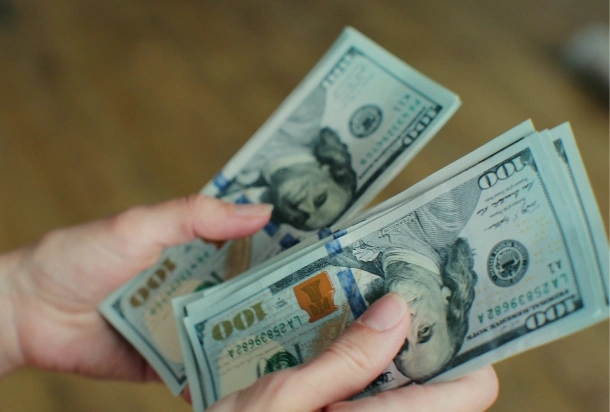
That’s why we recommend arriving with some cash in both currencies, preferably in small denominations. In a small shop, paying with a 10,000-colón or $20 bill can be a problem because they may not have enough change. With dollars, it is also best to avoid $50 and $100 bills: some businesses do not accept them because of concerns about counterfeiting. If you buy dollars from us, ask for $20 bills or smaller denominations.
What we do not recommend is relying on exchanging euros when you arrive. Many Costa Rican banks do not offer this service, and the Spanish Ministry of Foreign Affairs warns that the euro-to-dollar exchange rate offered by local institutions can be unfavourable for European travellers.
.webp)
The banknotes and coins you’ll find
Costa Rican colón banknotes are made from polymer, with each denomination having its own colour, making them easy to distinguish: ₡1,000, ₡2,000, ₡5,000, ₡10,000 and ₡20,000. There is also a ₡50,000 banknote from an earlier series that remains legal tender, but it is rarely seen.
The coins have changed recently. Since 1 July 2026, the old-design 5, 10 and 25 colón coins have no longer been accepted as legal tender. The 5-colón coin has been withdrawn completely, while the 10- and 25-colón coins are now in circulation with a new design. If you have coins left over from a previous trip, you can only exchange them at a Costa Rican bank.
Tipping, cash machines and cards
Good news for travellers: in restaurants, the law requires the prices on the menu to already include taxes and the service charge. The price you see is the price you pay, and leaving an additional tip is entirely up to you.
Cash machines are available throughout the country, and in tourist areas many allow you to choose whether to withdraw colóns or US dollars. Before using one, check with your bank how much you will be charged for withdrawing cash abroad. Visa and Mastercard are accepted at most hotels, restaurants and shops, while American Express is much less widely accepted. In remote areas, card terminals may not work, so it is always worth carrying some cash.
.webp)
.webp)
Before leaving Spain
For tourist stays of up to 180 days, you do not need a visa, but you do need a passport: a Spanish national identity card (DNI) is not valid for entry into Costa Rica. You may also be asked to show a return ticket. The country's departure tax of $29 is usually already included in the price of your airline ticket, so there is no need to set aside cash to pay it at the airport.
If you are travelling with a significant amount of cash, bear in mind that Costa Rica requires you to declare amounts of $10,000 or more, both when entering and leaving the country. Spain has a similar rule: if you leave the country carrying €10,000 or more, you must declare it using the Spanish Tax Agency's S1 form.
Traveling soon?
Here's how to easily exchange your money:

1. Select currency
Choose your currency and the amount you need. Stock guaranteed on 65 currencies!

2. Select location & date
Choose from 18 branches for a free pick up. No need to prepay your order online

3. Collect & pay
Pay by card or in cash directly at the branch upon pick-up. You're now all set for your trip!
Frequently asked questions about Costa Rican colóns
Ideally, take both: colóns for everyday expenses and dollars for hotels and excursions.
It can be difficult. Many banks do not exchange euros and the rate is often unfavourable, so the simplest option is to leave Spain with both colóns and dollars.
Enough to cover a few days of small expenses. The rest can be paid by card or in dollars.
We recommend arranging your euro-to-CRC exchange as far in advance as possible to give yourself the best chance of benefiting from the most favourable exchange rates.
Our BuyBack Guarantee is an ideal solution if you are unsure how much money to exchange before your trip. By taking out the guarantee, you can return any unspent CRC to us once you are back in Spain, and we will buy them back at the same exchange rate.
No. The old-design 5, 10 and 25 colón coins ceased to be valid on 1 July 2026.